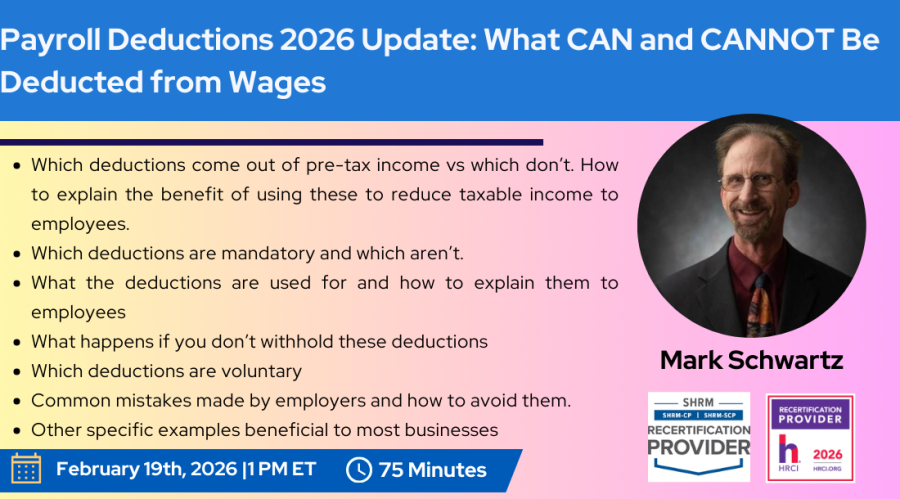
Payroll Deductions 2026 Update: What CAN and CANNOT Be Deducted from Wages

  • shape
  • shape
  • shape
  • shape

SHRM & HRCI Approved Webinar | CEUs = 1.25 Credit Hours

Overview:

Payroll deductions are no longer just about federal and state taxes. Today’s employers must navigate a complex mix of pre-tax and post-tax benefits, business expense deductions, wage garnishments, and evolving federal and state rules—where even small mistakes can lead to costly penalties.

With new changes under the One Big Beautiful Bill (OBBB) impacting overtime and tip deductions, payroll compliance is entering a high-risk phase. Do your systems and processes meet the new requirements?

This webinar delivers a practical, employer-focused breakdown of what can—and cannot—be deducted from employee wages. Learn how the FLSA regulates deductions for business expenses, especially for lower-wage workers, how to distinguish mandatory versus voluntary deductions, and how to correctly handle garnishments and levies. We’ll also highlight the most common payroll deduction errors that trigger Department of Labor fines, state-level violations, and unexpected employer liability.

Join Mark Schwartz for this essential compliance session and gain the clarity you need to protect your organization, reduce payroll risk, and stay ahead of regulatory change.

What will You Learn:

  • Which deductions come out of pre-tax income vs which don’t. How to explain the benefit of using these to reduce taxable income to employees.
  • Which deductions are mandatory and which aren’t.
  • What the deductions are used for and how to explain them to employees
  • What happens if you don’t withhold these deductions
  • Which deductions are voluntary
  • How to stay on the right side of rules and regulations on the matter. How to talk with employees about the benefits and disadvantages of voluntary deductions.
  • An understanding of when you CAN and CAN’T deduct business related expenses from employee paychecks.
  • Where to find information of State rules and regulation, which can and do differ greatly from Federal rules.
  • Common mistakes made by employers and how to avoid them.
  • Other specific examples beneficial to most businesses.
  • Wage Garnishments – the specifics on how to comply and how much to withhold
  • A brief description of other 3rd party deductions from your employee paychecks.
  • Penalties associated with non-compliance

Why you should Attend:

We all get familiar with payroll deductions when we earn our first paycheck. Usually, it is just mandatory state and federal taxes that make the difference between gross and net pay. After we gain experience and enter our careers, payroll deductions get far more tricky. Our employers offer us benefits for which we pay part or all – some pre-tax and some post-tax. Certain business expensed may get deducted. Taxing agencies and other creditors my garnish our wages.

From and employer perspective, the rules can get complicated. Not withholding what we should can have major consequences - as does deducting what we can’t. So, Join this webinar for more comprehensive look at payroll deduction DO’s and DON’Ts.

Who should Attend:

  • Payroll and HR managers
  • Compensation and hiring staff
  • Finance and Operational managers
  • Executive Staff
  • Any company that:
    • Offers fringe benefits
    • Has employees whose wages are garnished
    • Has business related expenses you want employees to pay for
    • Needs an understanding of FLSA and IRS regulations on this matter.

SHRM -

CEU Services is recognized by SHRM to offer Professional Development Credits (PDCs) for the SHRM-CPSM or SHRM-SCPSM. This program is valid for 1.25 PDCs for the SHRM-CPSM or SHRM-SCPSM. For more information about certification or recertification, please visit - portal.shrm.org.

HRCI -

This webinar has been approved for 1.25 HR (General) re-certification credit hours toward California, GPHR, HRBP, HRMP, PHR, and SPHR recertification through the HR Certification Institute.

The use of this seal is not an endorsement by the HR Certification Institute of the quality of the activity. It means that this activity has met the HR Certification Institute’s criteria to be pre-approved for re-certification credit.

Author Images
Mark Schwartz

M. Swratz earned a Master’s Degree in Business Administration from Santa Clara University. He worked for 8 years as an internal auditor for private and public entities. He evaluated business operations for efficiency and effectiveness. This included regulatory compliance, financial reporting and divisions’ ability to meet and exceed goals and standards set by the organization. He evaluated CalPERS’ payroll and HR division, one of the largest such divisions in California State Government. M. Swratz has processed payrolls for approximately 1 dozen small to medium sized businesses in Sacramento. He was also a payroll tax auditor for the State of California. His most complex business included multiple shifts, overtime calculations, garnishments, wage differentials, FLSA compliance and other wage and labor issues. His payroll software is flexible to all needs of the small business community. M. Swratz has provided consultation services for 8 different national payroll webinar providers. He has a wide presence, speaking to audiences on 20 different payroll tax related topics. These include Multi-State Employment, Fringe Benefits, Audits, Root-Cause analysis, Payroll Related Fraud, and many others. This forces Philip to keep up on all the latest payroll laws and regulations in all 50 states. This ensures both accuracy in processing your payroll, but also the flexibility and knowledge to grow with your business.